
Browser Automation
BrowserTrace
Local failure timeline debugger for AI browser-agent runs
Visible, persistent local browser workspaces for coding agents over MCP
Overview
This summary uses submitted and public product material. Only source-mapped claims are documentation reviewed.
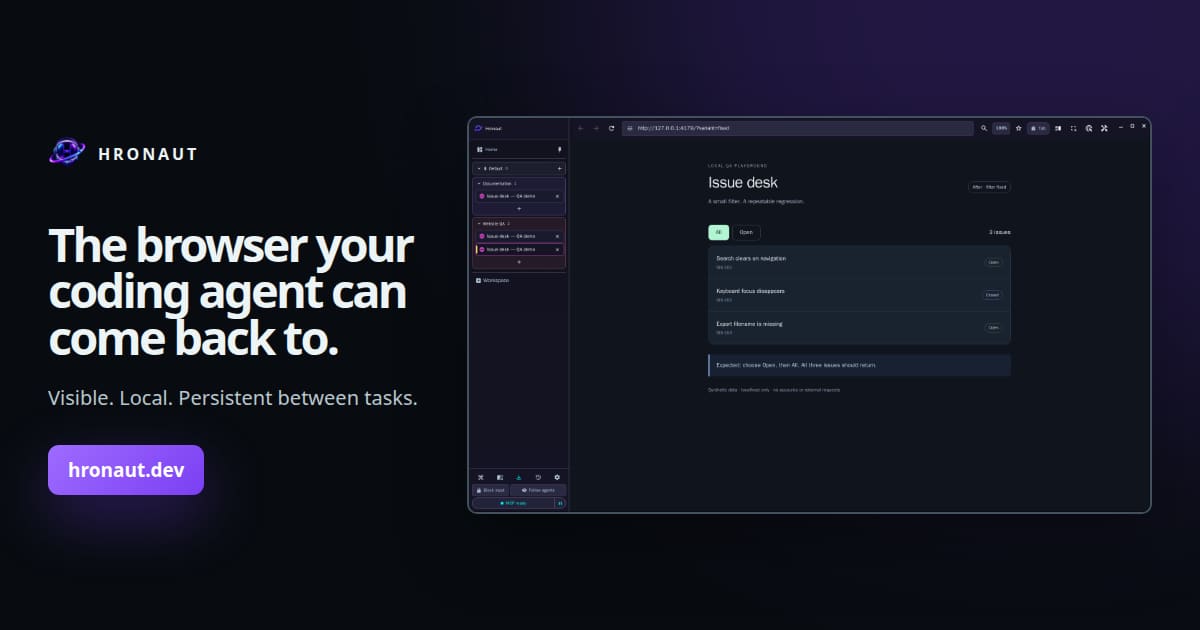
Hronaut is a visible, persistent Electron browser that exposes durable local agent workspaces through MCP. Each workspace keeps its own browser profile and site data, while people can watch, pause, approve, or take over a task when a manual step is required.
Start Hronaut, copy the configuration for a compatible local MCP client from Home, then ask the agent to create an isolated workspace named first-check, open https://example.com, take a semantic snapshot and report the page heading. Keep the task within that workspace. This is a suggested first check from the setup documentation, not an independently benchmarked integration.
For authenticated work, a person signs in inside the Hronaut workspace and handles any 2FA or consequential step. The caller checks the live context and result before continuing. See the setup guide and starter workflows.
One 10-day trial starts with the first agent tool call; no card or automatic billing is required for the trial. Ongoing use is $4/month or $24/year per named user, with up to three active devices per seat. Source inspection is permitted under the Hronaut Subscription and Trial License.
Listing decision
The agent-facing value is substantive: an agent can operate a named browser workspace through MCP and resume after a session boundary while a person retains visible control of consequential steps.
Before you choose
Coding agents that need a named visible local browser workspace, persistent tabs between sessions, human takeover during sign-in, 2FA, or consequential writes, and authoritative read-back after browser actions.
Teams seeking a hosted browser fleet, stealth or CAPTCHA-solving service, unattended cloud execution or a general-purpose agent memory layer.
Hronaut runs web pages in its own local Electron/Chromium application; it is not a hosted browser service, native desktop controller or orchestration platform. It does not automatically inherit another browser’s authenticated profile or enterprise device-trust extensions. Compatibility depends on the calling MCP client and site. The source-available product requires a subscription after its limited trial, and current desktop artifacts are unsigned/not Apple-notarized.
Compatibility with a specific coding-agent client depends on that client’s local Streamable HTTP MCP support and the active Hronaut profile configuration.
Sources
First-party unless marked otherwise. Each link supports only its adjacent claim.
Hronaut describes a local visible browser workspace for coding agents, with a 10-day trial followed by paid named-user plans and no automatic conversion from the trial.
official product page · accessed Sep 17, 2026The public repository documents a visible persistent Electron browser, durable agent workspaces over MCP, named local browser context, human takeover, and authoritative postcondition read-back.
official repository · accessed Sep 17, 2026This release documents workspace metadata repairs, retryable Memory Saver and page recovery, and partitioned-cookie isolation during workspace data copies. The desktop artifacts are not platform code-signed or Apple-notarized.
official release notes · accessed Sep 17, 2026The source-available license permits one 10-day trial starting with the first agent tool call, then requires $4/month or $24/year per named user for up to three active devices. The trial requires no payment card and does not automatically convert to paid use.
official license · accessed Sep 17, 2026The guide explains starting the desktop app, copying the current client configuration from Home, connecting over loopback Streamable HTTP MCP, and verifying a first task in an isolated workspace.
official documentation · accessed Sep 17, 2026Browser Automation
Local failure timeline debugger for AI browser-agent runs
Browser Automation
Stealth browser automation with persistent sessions for agents
Browser Automation
Open-source autonomous browser framework for agent web tasks


Comments